Let's be honest about where we are. We've spent a few years building Large Language Models with spectacular "brains" and then acting shocked when they can't actually do anything. They can write you a sonnet about your calendar. They just can't open it. The brain is there. The hands are missing. The Model Context Protocol (MCP), and its browser-native sibling WebMCP, are the standards racing to fix exactly that, and yes, you should be paying attention.
So what is MCP, really?
MCP is an open-source standard for plugging AI applications into the outside world: external systems, data sources, the workflows you actually use all day. The pitch everyone repeats is that it's the "USB-C port for AI applications", and for once the analogy holds up. One connector, any device. One protocol, and suddenly agents like Claude or ChatGPT can talk to your tools without a custom integration for every single one.
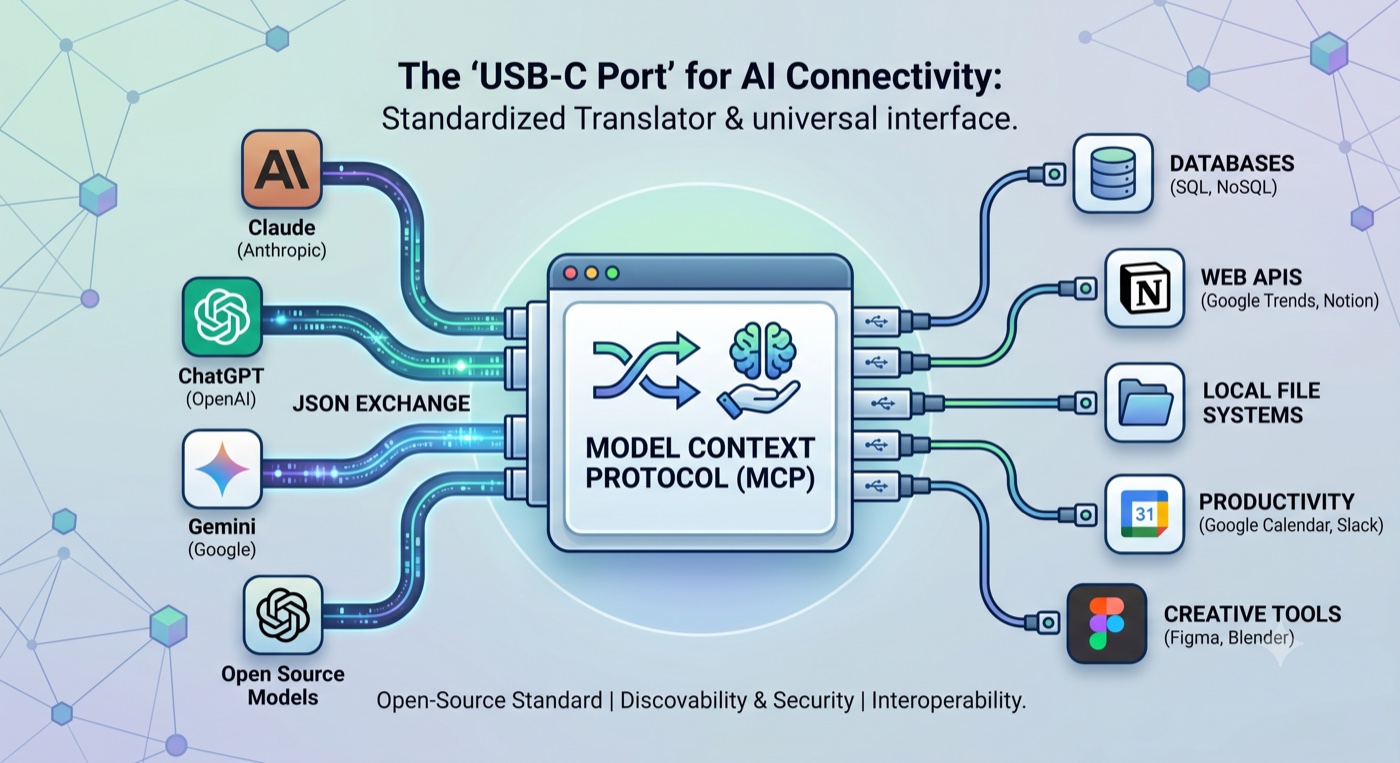
Strip away the buzzwords and MCP is a translator. It sits in the middle, between the agent and whatever it's reaching for, a database, a search engine, your local files, and lets the agent get information or take action without knowing a thing about the code underneath. The agent asks. The tool delivers. Nobody has to care how the sausage gets made.
How it actually works
No magic here, which is the whole point:
- Separation of concerns: The tool runs as its own program, in its own process, walled off from the agent. If it blows up, it blows up alone.
- A boring, standard pipe: The agent talks to the MCP server over standard input and output (stdin/stdout). Unglamorous. Reliable.
- It can introduce itself: The agent asks the server, "What tools do you have?" and the server hands back a menu, names, the arguments each one needs, what they do.
- JSON in, JSON out: The agent sends a tool name and a JSON bundle of arguments. The result comes back as a JSON payload. That's the whole conversation.
What you can actually do with it
This is where MCP stops being a chatbot parlor trick and starts being useful. A few things people are already doing:
- Grounding in reality: An agent pulls live data, say, Google Trends, instead of confidently making things up from stale training data. Revolutionary concept, I know: checking before you speak.
- Actual personal assistance: Agents reach into your Google Calendar or Notion to wrangle your schedule and notes. The assistant that finally assists.
- Design that ships: AI spins up web apps from Figma files, or builds 3D models in Blender and fires them straight at a 3D printer.
- Enterprise, unlocked: Chatbots hook into a stack of internal databases so employees can run real data analysis by just asking in plain English. No SQL required, no ticket to the data team.
WebMCP: dragging this onto the open web
General MCP mostly lives near local or server-side tools. WebMCP is the proposed web standard that takes the same idea and hands it to anyone running a website, structured tools, exposed straight through the browser.
Goodbye, "actuation" (and good riddance)
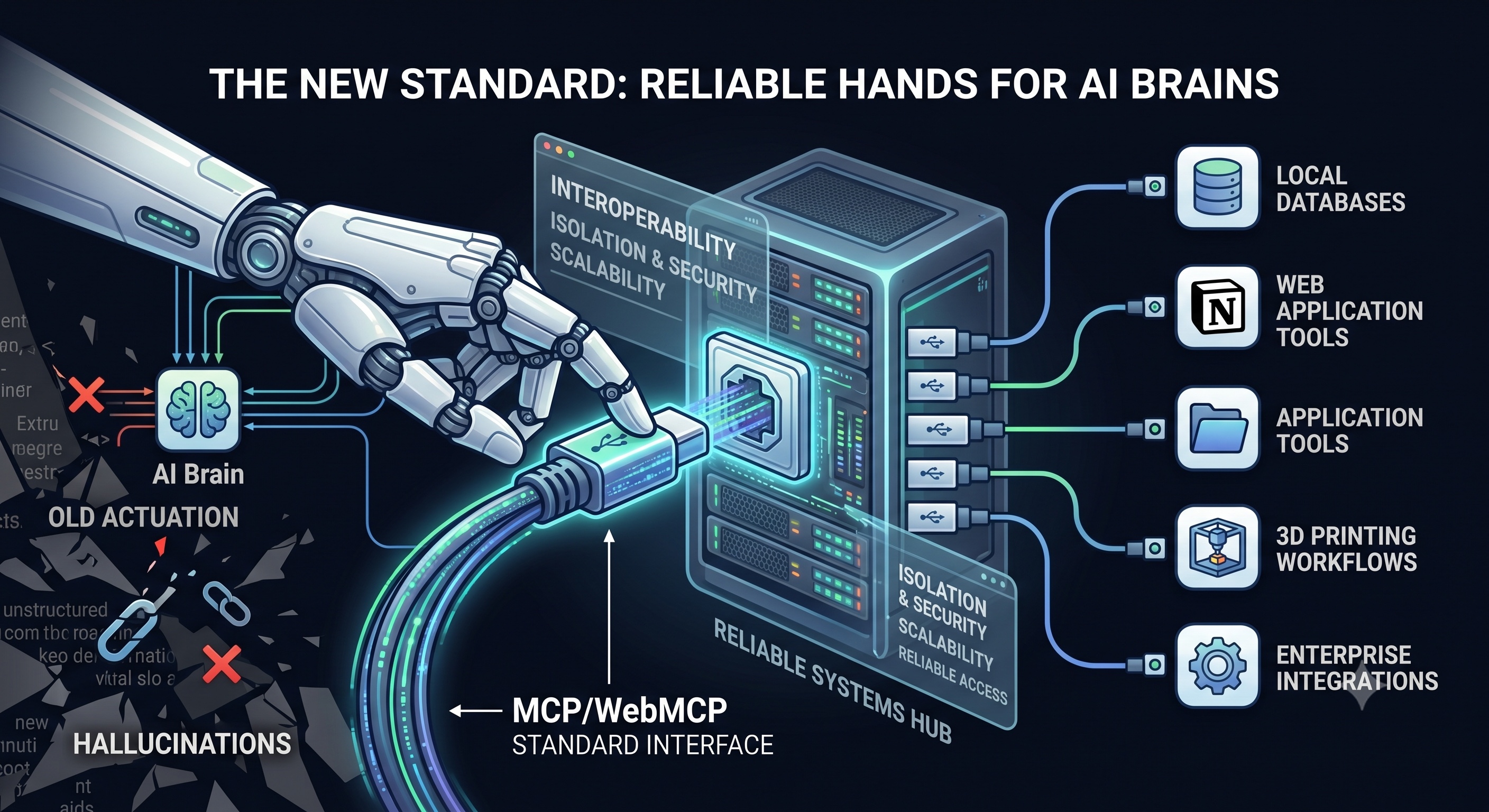
Here's the part nobody likes to admit. Until now, agents "used" websites by faking it, an approach charmingly called actuation: simulating mouse clicks and typing, cosplaying as a human. It's exactly as fragile as it sounds. The agent misreads a button, fills the wrong field, and your "autonomous assistant" just booked a flight to Cleveland. WebMCP kills the guessing. It lets a website declare what it actually does, so instead of the agent improvising, the site spells out the rules.
The two APIs
WebMCP gives developers two ways to do this:
- Imperative API: Plain JavaScript for the complicated stuff, navigation, state, app-specific functions.
- Declarative API: Annotate your standard HTML form elements so an agent knows precisely how to use them. No interpretive dance required.
Hand the agent JSON Schemas for inputs and outputs and a lot of the "hallucination" problem quietly goes away. The agent picks the right dates, fills the multi-step form, and stops freelancing.
Why any of this matters
Standards are deeply unsexy, and they're also how every important thing in tech actually got built. What you get here:
- Interoperability: Build a tool once, in whatever language you like (Python, Go, Node), and it works with any AI client that speaks the protocol. Write once, plug in everywhere.
- Isolation and security: A tool crashes, the agent shrugs and keeps going. And WebMCP brings real guardrails, origin isolation, permissions policies, so tools only fire in contexts you actually trust. Because letting an AI loose on the web with no fence is a headline waiting to happen.
- Scalability: Swap tools in and out without rewriting the agent's core. Add capabilities like Lego, not like open-heart surgery.
So here's the bottom line. As these protocols spread, AI's much-hyped "brains" finally get the reliable, standardized "hands" they've been missing, the ones they need to work your local machine and the sprawling mess of the open web. Less hype, more plumbing. That's usually when things get real.